Sunday, March 11, 2012

Braided Lemon Bread

Ingredients:

sponge

dough

cream cheese filling

Directions:
In a small bowl, combine the sponge ingredients. Stir well to combine, loosely cover with plastic wrap, and set aside to proof for 10 to 15 minutes.
1) In the bowl of your stand mixer combine the sponge, yogurt, butter, eggs, sugar, salt, and flavoring. Add 4 1/2 cups of flour and mix with the paddle attachment until the dough is a rough, shaggy mass. Switch to the dough hook and knead on speed 2 until a soft, smooth dough forms, about 5 to 6 minutes, adding more flour if needed to achieve the correct consistency.

If you're using a bread machine, combine all the dough ingredients in the pan and set the machine on the dough cycle. Be sure to check the dough as it kneads and adjust the flour or water as needed to achieve a soft, supple consistency. Let the cycle complete itself.
2) If working by hand or stand mixer, place the kneaded dough in a lightly greased bowl, cover with plastic wrap, and allow to rise for 60 to 90 minutes, until quite puffy and nearly doubled.
3) While the dough is rising, prepare the filling. Combine all the filling ingredients (except the lemon curd) in a small bowl, mixing until smooth and lump-free. Reserve the filling and lemon curd until ready to fill the braids.
4) Gently deflate the dough and divide it in half. Cover half with plastic wrap and set it aside as you roll out the first piece into a 10" x 15" rectangle. Rolling on parchment paper makes moving the bread to the baking sheet much, much easier. Lightly press two lines down the dough lengthwise, to divide it into 3 equal sections. Spread half the cream cheese filling down the center section, and top with half the lemon curd, leaving 1" free on all sides of the filling.
5) To form the mock braid, cut 1" crosswise strips down the length of the outside sections, making sure you have the same number of strips down each side. Beginning on the left, lift the top dough strip and gently bring it across the filling diagonally. Repeat on the other side with the top dough strip, so that the two strips crisscross each other. Continue down the entire braid, alternating strips to form the loaf
6) Repeat the rolling, filling, and braiding steps for the second piece of dough, using the remaining cream cheese filling and lemon curd. Set both loaves aside, lightly covered, to rise for 45 to 50 minutes, or until quite puffy
7) Preheat the oven to 375°F. Brush the loaves with egg wash (one lightly beaten egg, 2 teaspoons water and a pinch of salt), and sprinkle with coarse sparkling sugar, if desired. Bake for 25 to 30 minutes, or until the loaves are golden brown. Remove from the oven and cool for 15 to 20 minutes before serving.
Yield: 2 loaves.
Courtesy: http://www.kingarthurflour.com/recipes/braided-lemon-bread-recipe

Grounded and growing.


Week 1

Friday, February 17, 2012

Vaccinating Our Children for Sexually Transmitted Diseases?

November 2011. Last month, an advisory committee of the Centers for Disease Control and Prevention (CDC) in Atlanta recommended that 9 to 12 year old boys be vaccinated against the human papillomavirus (HPV), a virus transmitted through sexual contact. The goal of the recommendations was to prevent cancers caused by HPV, such as certain cancers of the digestive tract.

The same committee had already recommended, back in March of 2007, that girls and young women between the ages of 9 and 26 be vaccinated against HPV, to help prevent various cancers of the reproductive tract, such as cervical cancer.

While the motivation to prevent cancer and diseases is clearly good, a universal recommendation of this type raises ethical concerns. Because the recommendations of the committee relate to important aspects of human behavior and sexuality at formative ages for children and adolescents, parents need to look at the psychological and social messages they might be conveying by choosing to vaccinate their children against HPV. Beyond all the medical considerations, parents also have a duty to innoculate their children against harmful and immoral behaviors. Thus, decisions about vaccinations ultimately need to be made on a case-by-case basis within a particular family.

Parents are often rightly concerned that getting their kids vaccinated for a sexually-transmitted virus could be taken to signal tacit approval of pre-marital sex. Young people might surmise that their parents and physicians do not believe they can remain chaste, but instead begrudgingly expect them to become sexually active prior to marriage.

The widespread phenomenon of condom distribution among youth certainly conveys the same message, and young people today are not fools; they perceive how the culture around them has caved in on this question, no longer insisting, or even believing, that they have the wherewithal to refrain from pre-marital sex. Girls and boys are no longer treated as free individuals who can make higher and better choices when encouraged and supported, but instead are treated as mere creatures of sexual necessity.

I recall one time speaking with a middle-aged woman about the CDC vaccination recommendations. “When I was a girl, if my mom had taken me to get vaccinated for a sexually transmitted disease, I would have been horrified,” she said. “I would have wondered to myself, ‘What does she suppose I am, a tramp or something?’”

Parents do need to be careful about conveying a sense of fatalism when it comes to questions of the sexual behavior of their kids. Against the backdrop of a highly permissive culture, parents, who are the first educators of their children in sexual matters, are right to be concerned about sending conflicting messages.
Pursuing universal vaccination for sexually transmitted diseases like HPV could have the unintended effect of setting up a false sense of security, a kind of mental “safety net,” for boys and girls who are potentially sexually active. In the hormonally-charged environment of adolescence, young people might come to believe that the risks of premarital sex would be reduced by the vaccination, to the point that they would be "protected" and could risk promiscuous behaviors, when in fact, they would be increasing their odds of contracting sexually transmitted diseases (STDs) of any kind.

To consider an example where using the HPV vaccine might be sensible, we could consider a young woman who had been chaste all her life but who was preparing to marry a man whom she suspected had been sexually active (and might therefore expose her to HPV in their marriage). She could decide, prior to marriage, that receiving the HPV vaccination would be reasonable, and even without any suspicions about her future spouse’s past behavior, she might still prefer to leave nothing to chance.

Evaluating the potential risks and benefits of vaccinating boys or young men would similarly indicate various situations where the HPV vaccination would be reasonable. Also, at younger ages, children may not need to know the exact purposes behind a vaccination. They could simply be told by their parents (if they even asked) that the vaccine would protect them against possible cancers in the future.

Parents themselves, however, might still have doubts about the safety of the HPV vaccine, given that its side effects and complications are still being actively debated and studied. They might still have questions about its long-term benefits since it affords only a 5 year window of protection, and has only been surmised, but never scientifically demonstrated, to prevent cancer at a timepoint far in the future.

In sum, many factors need to be considered. Rather than a universal mandate, a careful, case-by-case risk/benefit analysis ought to be made by each family to determine whether the HPV vaccine is a reasonable choice, not only medically, but also in terms of where a young person may be in his or her life as a “moral agent.”

Rev. Tadeusz Pacholczyk, Ph.D. earned his doctorate in neuroscience from Yale and did post-doctoral work at Harvard. He is a priest of the diocese of Fall River, MA, and serves as the Director of Education at The National Catholic Bioethics Center in Philadelphia. See www.ncbcenter.org

Monday, February 6, 2012

"Goals are dreams with a deadline."

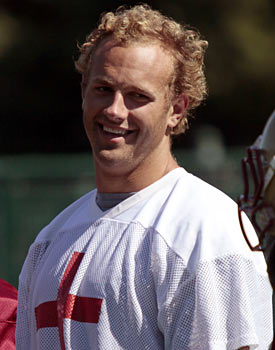
A bout with cancer can't keep Mark Herzlich off the field forever. (AP)-Mark Herzlich
 cancer survivor,
 New York Giants Linebacker

Tuesday, January 24, 2012

Never Settle

What does all this business about love come down to for you? Simply this: never settle for less than the spiritual and moral grandeur which, by grace, can be yours. They are your baptismal birthright as a Christian.
     You will fail. You will stumble on the ladder of love, and you will fall. That's no reason to lower the bar of expectation. That's a reason to get up, dust yourself off, seek forgiveness and reconciliation, and try again. If you settle for anything less than the greatness for which you were made - the greatness that became your destiny at baptism - you're cheating yourself. If you settle for anything less than the greatness that has been made possible for you by Christ, you're ignoring the twitch of the divine weaver on the thread of your life. Let His grace lift you up to where, in your heart of hearts, you want to be.
-George Weigel

Tuesday, January 10, 2012

A messenger


Kibeho with Immaculee"It’s the greatest story never told: that of a boy who met Jesus and dared to ask Him all the questions that have consumed mankind since the dawn of time.
His name was Segatashya. He was a shepherd born into a penniless and illiterate pagan family in the most remote region of Rwanda. He never attended school, never saw a bible, and never set foot in a church.
Then one summer day in 1982 while the 15-year-old was resting beneath a shade tree, Jesus Christ paid him a visit. Jesus asked the startled young man if he’d be willing to go on a mission to remind mankind how to live a life that leads to heaven. Segatashya accepted the assignment on one condition: that Jesus answer all his questions—and all the questions of those he met on his travels—about faith, religion, the purpose of life, and the nature of heaven and hell. Jesus agreed to the boy’s terms, and Segatashya set off on what would become one of the most miraculous journeys in modern history.
Although he was often accused of being a charlatan and beaten as a result, Segatashya’s innocent heart and powerful spiritual wisdom quickly won over even the most cynical of critics. Soon, this teenage boy who had never learned to read or write was discussing theology with leading biblical scholars and advising pastors and priests of all denominations.
He became so famous in Rwanda that the Catholic Church investigated his story. The doctors and psychiatrists who examined Segatashya all agreed that they were witnessing a miracle. His words and simple truths converted thousands of hearts and souls wherever he went.
Before his death during the 1994 Rwandan genocide, Segatashya continued his travels and conversations with Jesus for eight years, asking Him what we all want to know: Why were we created? Why must we suffer? Why do bad things happen to good people? When will the world end? Is there life after death? How do we get to Heaven?
The answers to these and many other momentous, life-changing questions are revealed in this riveting book, which is the first full account of Segatashya’s remarkable life story. Written with grace, passion, and loving humor by ImmaculĂ©e Ilibagiza, Segatashya’s close friend and a survivor of the Rwandan holocaust herself, this truly inspirational work is certain to move you in profound ways.
No matter what your faith or religious beliefs, Segatashya’s words will bring you comfort and joy, and prepare your heart for this life . . . and for life everlasting."


The Boy Who Met Jesus: Segatashya of Kibeho - SIGNED!

Source: http://www.immaculee.biz/The-Boy-Who-Met-Jesus-Segatashya-of-Kibeho.html